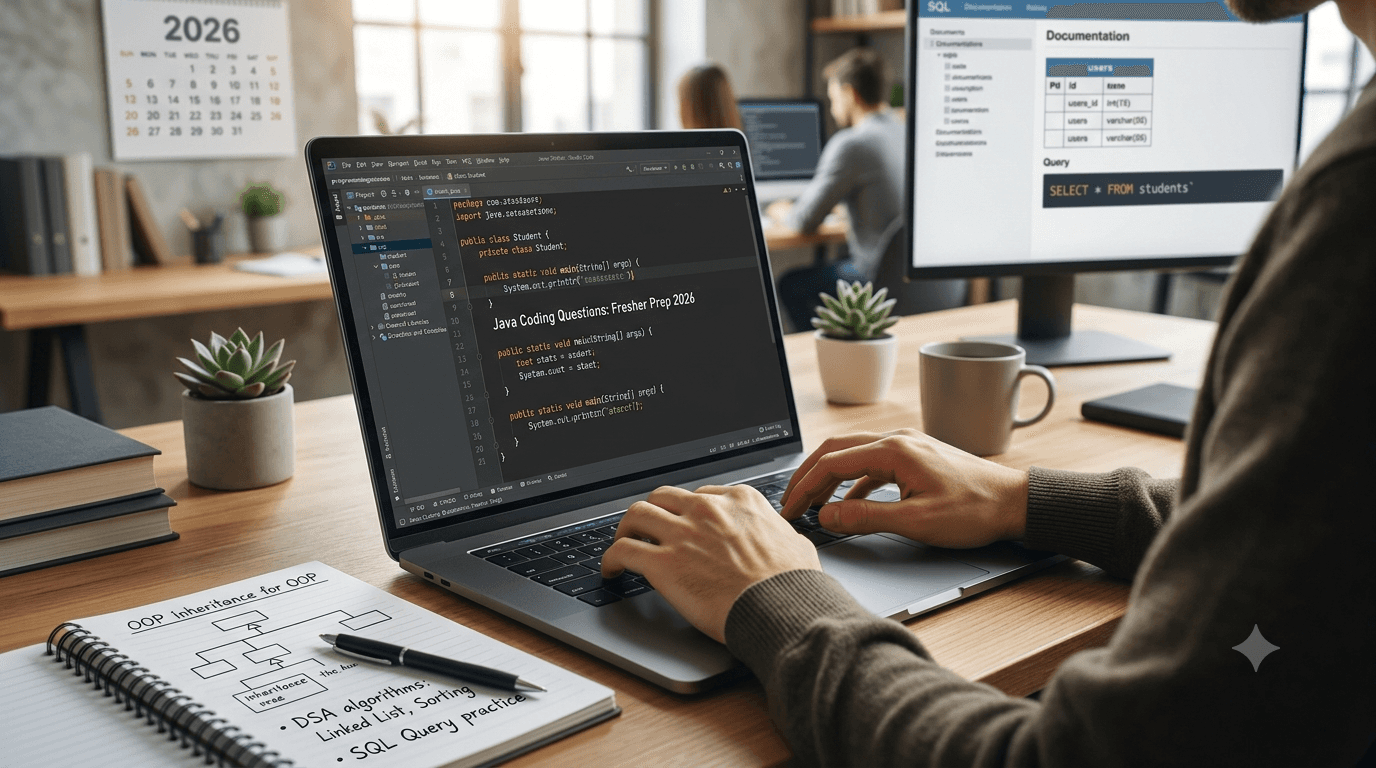
How to Start a Career in IT in 2026:

Starting a career in IT in 2026 can feel confusing.
You may have a degree but no practical experience.
You may know some programming but not know which IT job to target.
You may be from a non-technical background and wonder whether you can enter software development.
You may have learned Java, Python, SQL or another technology but still be unsure about how to turn that knowledge into your first IT job.
These are common problems for freshers.
The good news is that starting an IT career does not require learning every programming language, collecting dozens of certificates or mastering every technology before applying for your first job.
What matters is building a clear career direction, job-relevant technical skills, practical experience, communication ability and a consistent job-search strategy.
This guide explains how to start a career in IT in 2026, what skills to learn, which entry-level IT roles to consider, how to choose a technology, what projects to build, how to prepare for coding tests and interviews, how AI is changing IT skills, and how to move from beginner to job-ready candidate.
Why Starting an IT Career in 2026 Looks Different
The IT industry continues to change quickly.
Artificial intelligence, cloud computing, cybersecurity, data platforms, software development and automation are changing the technologies companies use and the skills they expect from employees.
The World Economic Forum's Future of Jobs Report 2025 identifies AI and big data, networks and cybersecurity, and technological literacy among the fastest-growing skill areas through 2030. It also highlights analytical thinking, creative thinking, resilience, flexibility, agility and curiosity as increasingly important skills.
That does not mean every fresher needs to become an AI engineer.
It means you should build a foundation that allows you to learn and adapt as technology changes.
For someone starting an IT career in 2026, this creates an important principle:
Do not try to learn everything. Learn enough of the right things to become useful in one target role.
What Does “Starting a Career in IT” Actually Mean?
Starting a career in IT does not necessarily mean becoming a software developer.
The IT industry includes many different career paths.
Some common entry-level paths include:
Career Path | Examples of Entry-Level Roles |
|---|---|
Software Development | Java Developer, Software Developer, Junior Developer |
Full Stack Development | Full Stack Developer, Junior Full Stack Developer |
Backend Development | Java Backend Developer, Spring Boot Developer |
Software Testing | Manual Tester, QA Tester, Automation Tester |
Data | Data Analyst, Junior Data Analyst |
IT Support | Technical Support Engineer, Service Desk Associate |
Cloud & Infrastructure | Cloud Support Associate, Junior Cloud Engineer |
Cybersecurity | Security Analyst Trainee, SOC Analyst |
Database | SQL Developer, Database Support |
Application Support | Application Support Engineer, Technical Support |
The right starting point depends on your education, interests, aptitude, current skills and the type of work you want to perform.
First Question: Which IT Career Is Right for You?
Before searching for courses or jobs, answer five questions.
Question 1: Do I enjoy programming?
If yes, consider:
Java development
Full Stack development
Backend development
Python development
Software engineering
Question 2: Do I enjoy finding problems and testing applications?
Consider:
Software testing
QA
Automation testing
Question 3: Do I enjoy working with numbers and data?
Consider:
Data analytics
SQL
Business intelligence
Data science
Question 4: Do I enjoy systems, infrastructure and troubleshooting?
Consider:
Cloud
Technical support
System administration
DevOps
Question 5: Am I interested in security?
Consider:
Cybersecurity
SOC operations
Security testing
Network security
You do not need to know the final answer immediately.
Your first objective is to choose one direction for the next few months.
Do You Need a Computer Science Degree to Start an IT Career?
A computer science or engineering degree can be useful for many entry-level IT roles, but the eligibility requirements vary by employer and job.
Companies may recruit candidates from:
BE
BTech
BCA
MCA
BSc
BCS
MSc
MCS
Other relevant degrees
Some positions have specific educational requirements.
Others focus more heavily on technical skills, projects, assessments and interviews.
Therefore, do not assume:
“I am not from CSE, so I cannot enter IT.”
Instead, check the eligibility requirements for the specific role you want.
Your goal should be to build enough relevant knowledge to demonstrate that you can perform the work.
Can a Non-IT Graduate Start a Career in IT?
Yes, depending on the role and employer requirements.
However, changing into IT requires deliberate preparation.
For example, someone with a non-computer background who wants to become a Java developer may need to learn:
The mistake is trying to learn all of these simultaneously.
Learn them progressively.
The Most Important Rule for IT Freshers
Do not choose a career path based only on:
Salary claims
Social media trends
A friend's recommendation
A course advertisement
The number of technologies mentioned in a job post
Instead, ask:
What type of work do I want to perform every day?
For example:
If you enjoy writing application logic, debugging and building features, software development may suit you.
If you enjoy identifying defects and validating software behaviour, testing may suit you.
If you enjoy numbers, SQL and business insights, analytics may be more suitable.
If you enjoy infrastructure and troubleshooting, cloud or support may be worth exploring.
Skills You Need to Start an IT Career in 2026
Your preparation can be divided into five layers.
Layer 1: Computer and Technical Fundamentals
Learn:
Operating system basics
Internet fundamentals
Browser concepts
Files and folders
Basic networking concepts
Software development basics
You do not need to become a network engineer.
You need enough technical awareness to understand the environment in which software operates.
Layer 2: One Primary Technical Skill
Choose one major technology.
Examples:
Java
Python
JavaScript
SQL
Testing
Cloud
Data analytics
Do not learn five programming languages at the same time.
For example:
Better approach
Poor approach
The second approach can create shallow knowledge.
Layer 3: Problem-Solving Skills
Programming is not only syntax.
You should learn how to:
Break a problem into smaller parts
Identify inputs
Identify outputs
Design logic
Handle edge cases
Debug errors
Improve inefficient solutions
For example, consider this problem:
Find the largest number in an array.
A beginner may immediately search for code.
A stronger approach is to think first:
Start with the first number.
Treat it as the largest.
Compare every next number.
Replace the largest when a bigger number appears.
Print the result.
Then write the code.
Output:
The important skill is understanding the logic.
Layer 4: Practical Development
After learning fundamentals, build something.
For a Java learner, this could be:
Student Management System
Employee Management System
Job Application Tracker
Inventory Management System
Course Management System
Placement Management System
The project should demonstrate your technical knowledge.
Layer 5: Employability Skills
Technical knowledge is only one part of the job search.
Develop:
Communication
Resume writing
Interview skills
Email etiquette
Presentation skills
Group discussion skills
Professional behaviour
Time management
The World Economic Forum also identifies skills such as analytical thinking, creative thinking, resilience, flexibility, agility and curiosity as important alongside technological skills.
The 2026 IT Career Skill Stack
A practical fresher skill stack can look like this:
The goal is balance.
Java as a Starting Point for IT Careers
Java remains a practical technology choice for candidates interested in backend or full stack development.
A Java-focused learning path can include:
Core Java
OOP
Collections
Exception handling
Multithreading
Java 8+
DSA
SQL
JDBC
Hibernate
Spring
Spring Boot
REST APIs
HTML
CSS
JavaScript
Git
GitHub
This creates a foundation for roles such as:
Java Developer
Junior Java Developer
Backend Developer
Spring Boot Developer
Full Stack Developer
Software Developer
Junior Software Engineer
Start With Core Java
Before learning Spring Boot, understand Java fundamentals.
Important concepts include:
Variables
Data types
Operators
Conditions
Loops
Arrays
Strings
Classes
Objects
Inheritance
Abstraction
Encapsulation
Polymorphism
Exception handling
Collections
Example:
This simple example introduces classes, objects, fields and methods.
Learn Object-Oriented Programming Properly
OOP is one of the most important Java foundations.
Understand:
Encapsulation
Keeping data and behaviour together and controlling access.
Inheritance
Creating a new class based on an existing class.
Polymorphism
Allowing the same interface or method concept to work in different ways.
Abstraction
Hiding unnecessary implementation details while exposing essential behaviour.
Do not learn these as definitions only.
Write code.
Practice DSA Alongside Java
You do not have to finish all DSA before building your first project.
Learn it progressively.
Start with:
Arrays
Strings
Searching
Sorting
Linked Lists
Stack
Queue
Recursion
Then move towards more advanced problem-solving.
Example: linear search.
Output:
Now ask yourself:
Why is the result 2?
Understanding this is more important than memorizing the program.
SQL Is a Career Skill, Not Just an Interview Topic
If you want to work in backend development, full stack development, testing or many data-related roles, SQL is worth learning.
Start with:
Example:
This query:
Selects employee name and salary.
Filters employees earning more than 40,000.
Sorts the result from highest salary to lowest.
Learn SQL Joins
Suppose you have two tables:
You can connect them using a JOIN.
Understanding joins is important because real applications often use multiple related tables.
Learn Spring Boot After Java Fundamentals
Once you understand Java, move towards backend development.
Spring Boot helps you create web applications and REST APIs using Java.
A basic REST controller might look like:
You should understand:
What a REST controller is
What an endpoint is
What GET means
What POST means
What PUT means
What DELETE means
What JSON is
How the service layer works
How the database is accessed
Understand REST APIs
A typical application might use:
These correspond to common CRUD operations.
This is the type of practical knowledge that helps connect programming theory to application development.
Build One Complete Project
Do not wait until you have learned every technology.
Build while learning.
For example:
Student Placement Management System
Possible features:
Student registration
Student login
Academic details
Skills
Resume information
Company registration
Job openings
Eligibility criteria
Applications
Shortlisting
Selection status
Technology stack:
This single project can give you opportunities to discuss many technical concepts during interviews.
Build Projects That Solve Real Problems
A project becomes easier to explain when it solves a problem.
Instead of:
“I made a website.”
Say:
“I developed a placement management application that allows students to maintain their profiles, companies to publish opportunities and administrators to track applications and shortlisting.”
The second explanation gives the interviewer something concrete to ask about.
What Should Be on Your GitHub?
Your GitHub repository should ideally contain:
Your README can include:
Project Overview
What problem does the project solve?
Features
What can users do?
Technology Stack
Which technologies were used?
Database
Which tables exist?
API Endpoints
What APIs are available?
Installation
How can another developer run it?
Future Improvements
What would you add next?
Learn Git Before Your First IT Job
At minimum, understand:
Also learn:
Repository
Commit
Branch
Merge
Pull
Push
Remote repository
You do not need to become a Git expert as a fresher.
But you should understand basic version control.
AI Skills for IT Freshers in 2026
AI is becoming part of software development and many other technology workflows.
The answer is not to ignore AI.
The better approach is to learn how to work with AI while maintaining technical understanding.
Use AI for:
Explaining errors
Generating test cases
Understanding documentation
Brainstorming solutions
Improving code readability
Creating initial drafts
Debugging suggestions
Learning unfamiliar concepts
But verify the output.
For example, if AI gives you:
Do not simply paste it.
Understand:
What
stream()doesWhat
filter()doesWhat the lambda expression means
What
collect()doesWhy a
Listis returned
The World Economic Forum reports that AI and big data are among the fastest-growing skill areas, but it also emphasizes human capabilities such as analytical thinking, creativity and adaptability.
Do You Need to Learn AI to Get an IT Job?
Not every entry-level IT role requires advanced AI knowledge.
If your goal is Java development, first build:
Then learn how AI tools can support your development workflow.
Do not replace your programming foundation with AI-generated code.
Certifications vs Practical Skills
A certificate can show that you completed a learning program.
It does not automatically prove that you can develop software.
For an entry-level technical role, combine:
Certificate + Skills + Project + GitHub + Interview Preparation
For example:
This gives you a more complete profile.
How to Know When You Are Job-Ready
You do not need to know everything.
You are moving toward job readiness when you can:
Write basic programs without copying every line
Explain OOP
Solve basic coding problems
Write SQL queries
Understand joins
Create basic REST APIs
Connect an application to a database
Use Git
Build at least one practical project
Explain your project
Debug basic errors
Answer technical questions
Communicate clearly
If you cannot do these yet, identify the weakest area and work on it.
A Simple Fresher Self-Assessment
Use this checklist.
Programming
I understand variables and data types.
I can write loops.
I understand arrays and strings.
I understand OOP.
I can solve basic coding problems.
Database
I can write SELECT queries.
I understand WHERE.
I understand JOIN.
I understand GROUP BY.
I can perform INSERT, UPDATE and DELETE.
Development
I understand REST APIs.
I understand CRUD.
I can explain backend architecture.
I can connect an application to a database.
Professional
My resume is updated.
My GitHub has a project.
I can explain my project.
I can introduce myself professionally.
I can answer basic HR questions.
How to Create Your First IT Resume
Your fresher resume does not need to be complicated.
A simple structure is:
For a technical fresher, projects should not be hidden at the bottom if they are one of your strongest forms of practical evidence.
How to Write Project Points on a Fresher Resume
Weak:
Made a student management project using Java.
Better:
Developed a Student Management System using Java, Spring Boot and MySQL with REST APIs for student CRUD operations.
Stronger:
Developed a Spring Boot-based Student Management System with REST APIs and MySQL integration, implementing CRUD operations, validation and database-driven student search.
The stronger version explains:
What you built
Technologies
Functionality
Practical implementation
How to Search for Your First IT Job
Do not depend on one source.
Use a combination of:
Company career pages
Campus recruitment drives
Fresher hiring drives
College placement cells
Professional networking
Recruitment events
Training and placement platforms
Verified recruitment communities
Maintain a simple tracker.
Company | Role | Date Applied | Status | Next Step |
|---|---|---|---|---|
Company A | Java Developer | 10 Sep | Applied | Wait |
Company B | Software Engineer | 12 Sep | Assessment | Prepare |
Company C | QA Trainee | 14 Sep | Interview | Revise SQL |
Company D | Backend Developer | 16 Sep | Shortlisted | Technical Round |
This prevents your job search from becoming disorganized.
How Many Jobs Should You Apply For?
Do not focus only on the number of applications.
Focus on relevant applications.
Before applying, check:
Eligibility
Degree requirements
Graduation year
Location
Technical skills
Experience requirement
Notice period if applicable
Application deadline
A relevant application is more useful than blindly applying to every job you see.
How to Prepare for Coding Tests
Common fresher coding topics include:
Numbers
Strings
Arrays
Loops
Sorting
Searching
Basic recursion
Collections
Hashing
Basic DSA
Practice questions such as:
For Java candidates, also practice:
Example: Character Frequency in Java
Possible output:
This small program introduces:
Strings
Character arrays
HashMap
Loops
Frequency counting
What Happens in a Typical Fresher Hiring Process?
The exact process differs by employer, but you may encounter:
Not every company uses every stage.
Prepare for the possibility of multiple assessment formats.
What Should You Revise Before a Java Interview?
Start with:
Core Java
OOP
Strings
Arrays
Collections
Exception handling
Multithreading
Java 8+
Lambda
Functional interfaces
Streams
Database
SQL
Joins
Group By
Subqueries
Constraints
Backend
Spring
Spring Boot
REST API
HTTP methods
JSON
Project
Architecture
Database
APIs
Challenges
Your contribution
How to Answer “Tell Me About Yourself”
A good fresher introduction can follow this structure:
Example:
“I recently completed my degree in Computer Science. I have been developing my skills in Java, SQL and Spring Boot, and I have worked on a student management project involving REST APIs and MySQL. I have also been practicing DSA and coding problems. I am currently looking for an entry-level software development opportunity where I can apply these skills and continue learning.”
Keep it natural.
Do not memorize a speech word-for-word.
Common Mistakes When Starting an IT Career
Trying to learn everything
Technology is too broad.
Choose one direction first.
Changing your career path every week
One week Java.
Next week data science.
Then cybersecurity.
Then cloud.
This creates fragmented knowledge.
Give your chosen path enough time to evaluate it properly.
Collecting certificates without practical work
Certificates cannot replace coding practice.
Copying projects
If you cannot explain your own project, the project has limited interview value.
Ignoring communication
Technical skills and communication both matter during interviews.
Applying without checking eligibility
Always read the job description carefully.
Giving up after rejection
Rejection can identify areas that need improvement.
Track what happened.
Was the issue:
Aptitude?
Coding?
Technical interview?
Communication?
Eligibility?
Resume?
Project explanation?
Then improve that specific area.
How to Start an IT Career After Graduation With No Experience
If you have graduated and still do not have an IT job, avoid spending months doing nothing while waiting for the “perfect opportunity.”
Use a structured approach.
Then continue improving while applying.
A 90-Day IT Career Starting Plan
Days 1–15: Choose Your Direction
Decide:
Development
Testing
Data
Cloud
Support
Cybersecurity
Choose one.
Research the skills commonly requested for that path.
Days 16–30: Build Fundamentals
For Java development:
Solve coding problems every day.
Days 31–50: Learn Job-Relevant Technologies
For a Java Full Stack path:
Start building your project.
Days 51–70: Complete Your Project
Finish:
Database
Backend
APIs
Frontend
Validation
Error handling
Testing
Upload it to GitHub.
Days 71–80: Build Your Professional Profile
Update:
Resume
GitHub
LinkedIn
Project documentation
Prepare your introduction.
Days 81–90: Interview + Applications
Every day:
The process should continue beyond 90 days.
How to Track Your Progress
You can create a simple weekly scorecard.
Area | Week 1 | Week 4 | Week 8 | Week 12 |
|---|---|---|---|---|
Java | Beginner | Basic | Intermediate | Stronger |
SQL | Beginner | Basic | Intermediate | Stronger |
DSA | Beginner | Basic | Intermediate | Stronger |
Project | 0% | 20% | 70% | 100% |
GitHub | 0 | Setup | Active | Documented |
Interview | Not started | Basic | Practicing | Mock-ready |
These are self-tracking stages, not industry scores.
Choosing Between Self-Learning and Structured Training
There is no single learning method that works for everyone.
Self-learning may suit you if:
You can create your own study plan.
You are comfortable finding documentation.
You can maintain consistency.
You can debug problems independently.
You can build projects without external accountability.
Structured training may suit you if:
You need a fixed curriculum.
You prefer instructor-led learning.
You need regular coding practice.
You want guided projects.
You need interview preparation.
You benefit from placement-oriented support.
The important thing is not simply where you learn.
The important question is:
Are you becoming capable of doing the work?
Starting an IT Career With VibrantMinds
For freshers looking for structured IT training in Pune, VibrantMinds Technologies Pvt. Ltd. provides job-oriented training and recruitment-related support through its candidate platform.
The current published course catalogue lists Full Stack Development, with the detailed program presented as a 6-month Full Stack Java Course in Pune covering technical training, practical coding and job-readiness preparation.
The current published course information includes:
Core Java
Java fundamentals
Variables
Data types
Operators
Conditions
Loops
Classes and objects
Inheritance
Abstraction
Encapsulation
Polymorphism
Strings
Arrays
Exception handling
Multithreading
Collections
Data Structures and Algorithms
Arrays
Linked Lists
Stacks
Queues
Linear Search
Binary Search
Selection Sort
Bubble Sort
Insertion Sort
Quick Sort
Merge Sort
Recursion
Java 8+
Functional interfaces
Lambda expressions
Method references
Stream API
Filtering
Mapping
Sorting
Aggregation
Reduction
Collectors
Java Web Development
JDBC
Servlets
JSP
MVC
Database-connected applications
Hibernate
Hibernate configuration
Session
SessionFactory
Annotations
Object states
Relationships
HQL
Fetching
Caching
Spring
IoC
Dependency Injection
Spring Beans
Spring JDBC
Spring Hibernate
Spring MVC
Validation
Spring Boot and REST APIs
Spring Boot fundamentals
Dependency Injection
REST services
JSON
Exception handling
REST API design
CRUD APIs
Database-connected applications
SQL and MySQL
SELECT
WHERE
Sorting
Filtering
DDL
DML
Constraints
INSERT
UPDATE
DELETE
Inner Join
Left Join
Right Join
Cross Join
Self Join
Subqueries
Aggregate functions
String functions
Conversion functions
Frontend Development
The current published curriculum includes:
HTML5
CSS3
JavaScript
DOM
Forms
Responsive design
AJAX
JSON
React.js
The current course page also lists technologies and tools including Git & GitHub, Postman, Docker, MySQL, MongoDB, React.js, Node.js and Express.js.
Practical Coding and Job-Readiness Training
The current VibrantMinds course information describes structured practical sessions involving:
Java programming
DSA problem-solving
SQL queries
Frontend exercises
Backend application development
Assignments
Revision
The published course information states that students can receive structured practical practice from Monday to Saturday.
The job-readiness component includes:
Aptitude preparation
Logical reasoning
Coding assessments
DSA interview preparation
Spoken English
Soft skills
Group discussion practice
Resume guidance
Mock interviews
Technical interview preparation
Placement assistance
The current published course page states 100% placement assistance and unlimited placement calls, subject to eligibility, individual performance, academic criteria and employer requirements.
That distinction matters.
Placement assistance is not the same thing as a guaranteed job.
Final selection depends on candidate performance and employer requirements.
VibrantMinds Course Eligibility and Learning Mode
The current course listing describes eligibility for:
BE
BTech
ME
MTech
BCA
MCA
BSc
BCS
MSc
MCS
Equivalent educational backgrounds
The course listing currently describes the mode as Hybrid, while the detailed course page states that students can attend through online or classroom training at VibrantMinds in Warje, Pune.
Because batch schedules, fees and course availability can change, candidates should confirm the current details directly before enrolling.
Career Roles After Full Stack Java Training
The published VibrantMinds course information identifies preparation for roles such as:
Full Stack Java Developer
Java Developer
Junior Java Developer
Backend Developer
Junior Backend Developer
Spring Boot Developer
Java Web Developer
Full Stack Developer
Software Developer
Junior Software Engineer
Associate Software Engineer
Graduate Engineer Trainee
Software Engineer Trainee
Application Developer
Web Application Developer
Java Support Engineer
Technical Support Engineer
Database Developer
SQL Developer
Programmer Analyst Trainee
The actual role offered depends on employer requirements, candidate eligibility, technical performance and the hiring process.
VibrantMinds' Candidate and Recruitment Ecosystem
VibrantMinds' official platforms describe an ecosystem connecting candidates, colleges and companies through training, assessments, campus recruitment and recruitment support. The official website currently reports 91,000+ candidates, 1,900+ colleges and 600+ companies across India.
Its candidate platform provides access to:
IT fresher opportunities
Campus recruitment drives
Job-oriented training
Course information
Career guidance
Recruitment updates
The candidate platform currently describes itself as a place for fresher recruitment drives, IT courses and career support.
Official VibrantMinds Course and Career Links
VibrantMinds Official Website
VibrantMinds Candidate Portal
https://candidates.vibrantminds.in/
Full Stack Java Course
https://candidates.vibrantminds.in/courses/full-stack-development
Candidates can use the official platform to check current course information, available opportunities, batch details and enquiry options.
Stay Updated With Fresher IT Job and Campus Drive Alerts
VibrantMinds also shares fresher job and campus-drive updates through WhatsApp groups.
VibrantMinds Fresher IT Jobs — Group 1
https://chat.whatsapp.com/CUCS1derlmTFee2c9dyUHd
Group 2
https://chat.whatsapp.com/FvMf1fGYQYnHppQ8AwFX40
Group 3
https://chat.whatsapp.com/I7RNnGMkb2L8S8HibdyWpQ
If one group is full, candidates can try another group.
Candidates should always verify the original company, job description and application instructions before sharing personal information or applying.
Never share:
OTPs
Passwords
ATM PINs
Bank credentials
Card information
Sensitive financial information
Be cautious about recruitment messages asking candidates to pay money to apply for a job.
VibrantMinds Contact Details
VibrantMinds Technologies Pvt. Ltd.
Address:
Viva Academy Building, Warje, Pune, Maharashtra 411052
Phone:
+91 95035 79517
Email:
support@vibrantmindstech.com
For current course fees, batch schedules, eligibility, availability and placement-support terms, contact VibrantMinds directly.
What Should You Do If You Are Completely Starting From Zero?
If you have never written code before, do not panic.
Start small.
Month 1
Learn:
Month 2
Learn:
Month 3
Learn:
Month 4
Build:
Month 5
Improve:
Month 6
Prepare:
This is a learning framework, not a guarantee that every learner will become job-ready in exactly six months.
Individual progress depends on prior knowledge, consistency and practice.
The 7-Day Starter Plan
If you are confused about where to begin, start with this.
Day 1
Choose one IT career direction.
Day 2
Read five job descriptions for that role.
Write down the recurring skills.
Day 3
Select one primary technology.
Day 4
Create a learning schedule.
Day 5
Write your first small program.
Day 6
Create your GitHub account and first repository.
Day 7
Create your first mini-project idea.
Do not spend the entire week comparing courses.
Start learning.
The First 10 Things You Should Do
If you are starting an IT career in 2026, your immediate action list can be:
Choose one target IT role.
Read relevant job descriptions.
Identify recurring technical skills.
Select one primary technology.
Start programming fundamentals.
Learn SQL.
Practice coding every day.
Build a practical project.
Create a professional resume and GitHub profile.
Start applying while continuing to learn.
IT Career Starting Checklist
Career Direction
I have selected a target role.
I understand what the role involves.
I know the basic skills required.
I have researched relevant job descriptions.
Technical Skills
I know one programming language or technical skill.
I understand basic problem-solving.
I know SQL if relevant to my role.
I understand the main tools used in my target role.
Practical Experience
I have built at least one project.
I can explain my project.
My project is documented.
My code is stored in GitHub.
Job Search
My resume is updated.
I track applications.
I check eligibility before applying.
I prepare specifically for each assessment.
Interview
I can introduce myself.
I can explain my technical skills.
I can explain my project.
I practice coding questions.
I practice SQL.
I practice HR questions.
Frequently Asked Questions
How can I start a career in IT in 2026?
Choose one IT career path, learn the technical skills required for that role, practice problem-solving, build practical projects, create a professional resume and GitHub profile, prepare for assessments and interviews, and apply consistently to relevant entry-level opportunities.
Which IT field is best for freshers in 2026?
There is no single IT field that is best for every fresher. Software development, testing, data, cloud, cybersecurity, technical support and other areas have different skill requirements. Choose based on your interests, strengths, educational background and target roles.
Can I get an IT job without experience?
Yes, entry-level roles are designed for candidates with limited professional experience, but employers can still evaluate technical skills, projects, coding ability, communication, aptitude and interview performance.
Can a non-CS student enter IT?
Depending on the role and employer's eligibility criteria, candidates from different educational backgrounds can pursue IT careers. The key is to develop the technical skills required for the target role.
Which programming language should a beginner learn in 2026?
There is no universal answer. Java, Python and JavaScript are examples of widely used technologies, but your choice should depend on the career role you want to pursue and the skills requested in relevant job descriptions.
Is Java good for starting an IT career?
Java can be a practical starting point for candidates interested in backend or full stack development. A Java learning path can include Core Java, OOP, DSA, SQL, Spring Boot, REST APIs and project development.
Is SQL important for freshers?
SQL is important for many development, testing, support and data-related roles. Learn SELECT, filtering, sorting, joins, grouping, aggregate functions and CRUD operations.
Do I need DSA for a Java developer job?
The amount of DSA required varies by company and role. Basic problem-solving and common data structures are useful for coding assessments and technical interviews.
Do I need a project to get an IT job as a fresher?
Not every employer requires a project, but practical projects provide evidence that you can apply what you have learned. A project also gives you something concrete to discuss during technical interviews.
Should I learn AI before Java?
If your target role is Java development, first build a strong programming foundation. You can then learn how AI tools can support coding, debugging, documentation and development workflows.
Can I learn IT skills online?
Yes. Online learning can work well when combined with hands-on coding, projects, documentation, assessments and consistent practice.
Is a certificate enough to get an IT job?
A certificate alone does not demonstrate complete job readiness. Combine certification with technical skills, projects, coding practice, communication and interview preparation.
How long does it take to become job-ready for IT?
There is no fixed timeline. Your learning speed depends on your starting level, chosen role, consistency, study time and practical experience. A structured plan can help you progress more efficiently.
What should I put on my fresher resume?
Include your education, technical skills, projects, certifications, GitHub or relevant professional links, achievements and concise career information. Make sure every technical skill listed is something you can discuss.
Where can I find fresher IT jobs?
Use company career pages, campus drives, recruitment platforms, college placement cells, professional networks and verified recruitment communities. Always verify the original job details before applying.
Final Thoughts: Start Small, Build Skills and Keep Moving
Starting a career in IT in 2026 does not require you to know everything.
You do not need to become an expert in every programming language.
You do not need to learn ten frameworks at once.
You do not need dozens of certificates.
Instead, build a focused foundation.
The IT industry will continue changing.
The technologies used today will evolve.
New tools will appear.
AI will change development workflows.
But the fundamentals remain valuable:
Problem-solving.
Technical understanding.
Practical experience.
Communication.
Curiosity.
Adaptability.
If you are starting from zero, your first objective should not be:
“How can I learn everything in IT?”
Instead, ask:
“What IT role do I want to prepare for, and what skills do I need to become useful in that role?”
Then build those skills step by step.
For candidates looking for structured Full Stack Java training, practical coding, DSA, SQL, Spring Boot, REST API development, frontend technologies, interview preparation and placement assistance, VibrantMinds Technologies provides a current Full Stack Java program through its candidate platform.
The most important step, however, is the one you take after reading this article.
Choose your direction.
Start learning.
Build something.
Keep improving.
And begin your IT career one practical skill at a time.