IT Jobs for Freshers Without Experience in 2026: Is It Really Possible?

The Honest, Data-Backed Answer — Plus a Realistic Plan to Get Your First Offer
Every fresher hits the same wall eventually: job postings that ask for "0–2 years experience" for an entry-level role, or worse, postings that quietly expect skills no fresher could reasonably have. It's fair to wonder whether IT jobs without experience genuinely exist in 2026, or whether it's just a phrase companies use loosely. The honest answer, based on real 2026 hiring data rather than motivational-post optimism, is: yes, entry-level IT hiring is real and substantial — but it runs through a different, narrower pipeline than general job postings, and knowing that pipeline matters more than anything else in this guide.
The Reality Check: What the 2026 Data Actually Shows
Two things are simultaneously true in 2026, and most advice online only tells you one of them:
• Fresher hiring is genuinely growing — Naukri's JobSpeak Index recorded fresher hiring (0–3 years) up 17% year-on-year in February 2026 alone, and industry body NASSCOM projects India will add over 3.5 lakh technology jobs in 2025–26, with freshers accounting for close to 45% of all new hires
• At the same time, entry-level roles are a small slice of general job postings — an independent analysis of over 15,000 live Indian tech postings in mid-2026 found only 5.9% were tagged entry-level or junior, while over half asked for senior candidates
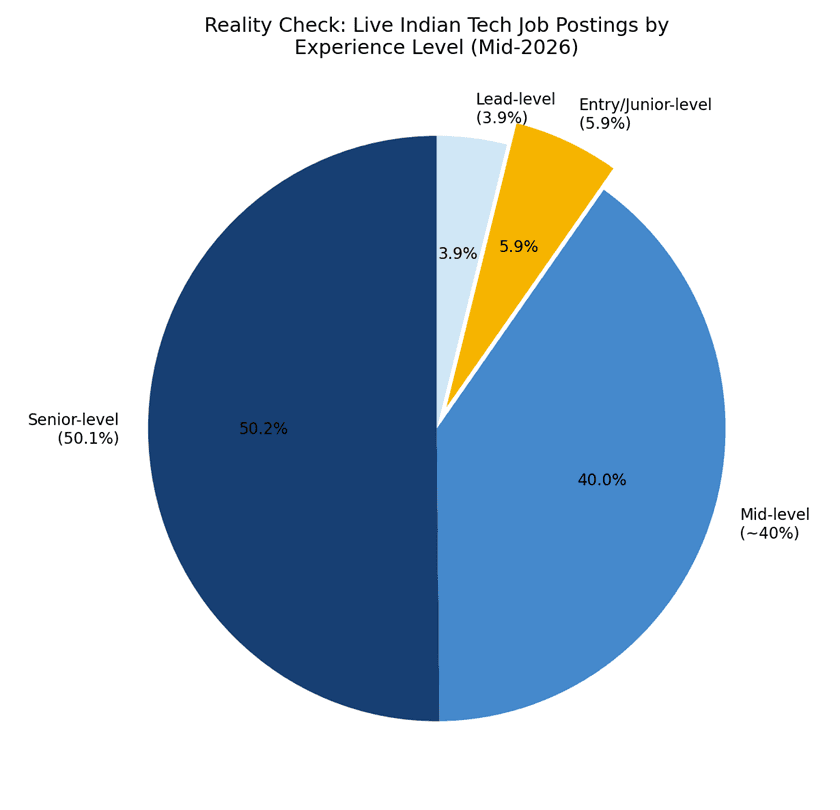
These two facts aren't actually in conflict once you understand why: most general job boards are dominated by lateral, experienced hiring, because that's how most companies fill most roles year-round. Fresher hiring, by contrast, happens through a separate, concentrated pipeline — campus drives, national qualifier tests, off-campus drives, and placement-linked training programs — that doesn't show up the same way in a general keyword search on a job portal.
Where the Real Fresher Openings Actually Are
Large IT services firms alone are planning to hire tens of thousands of freshers in FY26. Reported hiring targets from a recent industry report give a sense of scale:
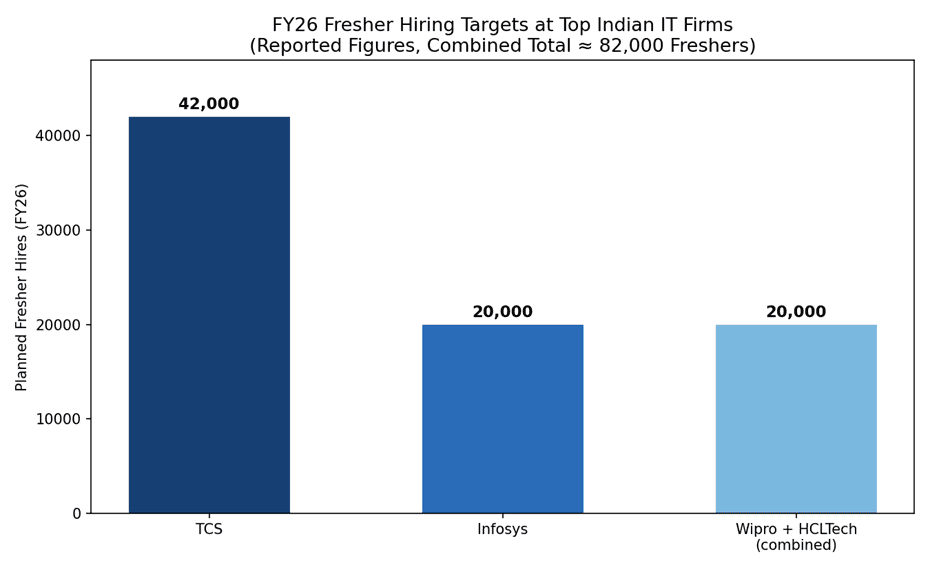
• TCS alone is targeting roughly 42,000 fresher hires in FY26, largely through its TCS National Qualifier Test (TCS NQT), open to graduates from any stream
• Infosys plans to onboard 20,000+ freshers in 2026 through its InfyTQ platform and campus drives
• Global Capability Centres (GCCs) — the India-based tech arms of global companies — plan to ramp up fresher hiring by up to 20% this year, and typically pay 12–20% more than comparable service-company roles
None of these openings require prior "work experience" in the traditional sense. What they do require is clearing a structured assessment — an aptitude test, a coding round, sometimes a group discussion — which is a very different bar than "experience," and one a well-prepared fresher can absolutely clear.
What Companies Actually Mean by "Experience" for a Fresher Role
This is the part that trips people up. When a fresher-track posting says "0–1 years experience," it's rarely asking for prior employment. In practice, what actually satisfies that line is:
• Academic or personal projects that demonstrate you can actually build something end-to-end
• Internships, even short or unpaid ones, that show you've worked in a real team environment
• Structured training program completion, especially one that included live or simulated projects
• Open-source contributions or hackathon participation, which signal initiative beyond the classroom
The label "fresher" already acknowledges you have zero paid work history — the real filter is whether you can demonstrate applied skill through something other than a transcript.
How to Build Real 'Experience' Before Your First Job
Not all experience-substitutes carry equal weight with recruiters. Based on what consistently gets attention in screening rounds:
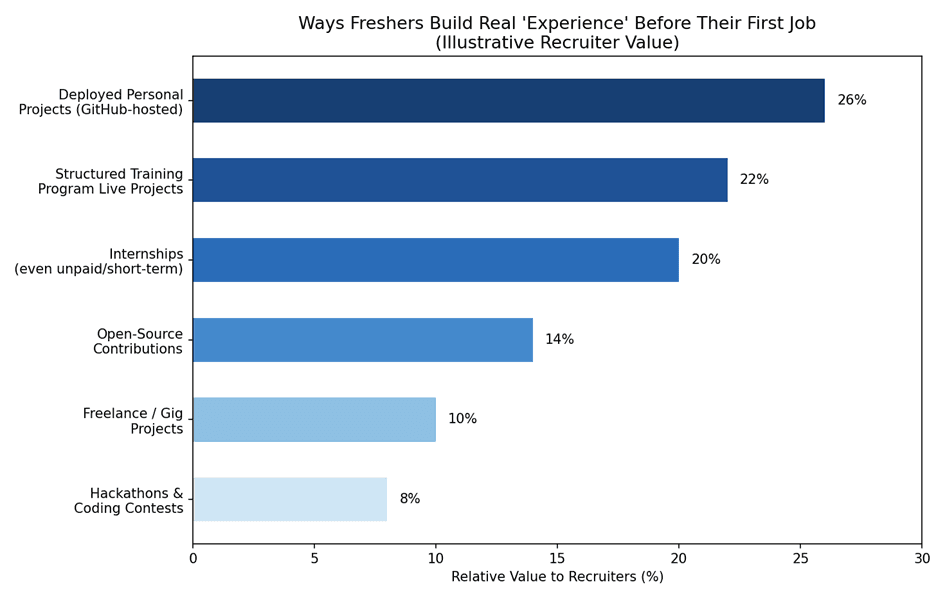
• Deployed personal projects (hosted, with a working link and a GitHub repo) carry the most weight — they're concrete proof, not a claim
• A structured training program with genuine live projects is close behind, especially when it's paired with a real placement pipeline rather than just a certificate
• Internships remain valuable even when short or unpaid, since they demonstrate real-world teamwork and process exposure
• Open-source contributions and freelance/gig work help, but usually as a supplement to the above rather than a replacement for it
• Hackathons and coding contests are a smaller but genuine signal, especially for freshers targeting product companies or GCCs
A Realistic Month-by-Month Plan
• Months 1–2: Build a solid foundation in one stack (for example, Java, Spring Boot, SQL) — don't skip fundamentals to rush toward frameworks
• Months 2–4: Build and deploy at least two real projects, ideally ones that solve a specific, describable problem rather than a generic to-do app
• Month 4: Start applying to structured entry points — TCS NQT, Infosys InfyTQ, GCC entry programs, and any active campus or off-campus drives
• Months 4–5: Layer in aptitude test practice and mock interviews alongside applications, not after them — these often run in parallel with your project work
• Months 5–6: Treat every rejection as data — track which round you're dropping out at (screening vs. technical vs. HR) and target that specific gap
This isn't a guaranteed timeline — market conditions, your starting skill level, and sheer luck in timing all play a role — but it reflects the order of operations that actually moves freshers from zero to an offer, rather than one that just accumulates certificates.
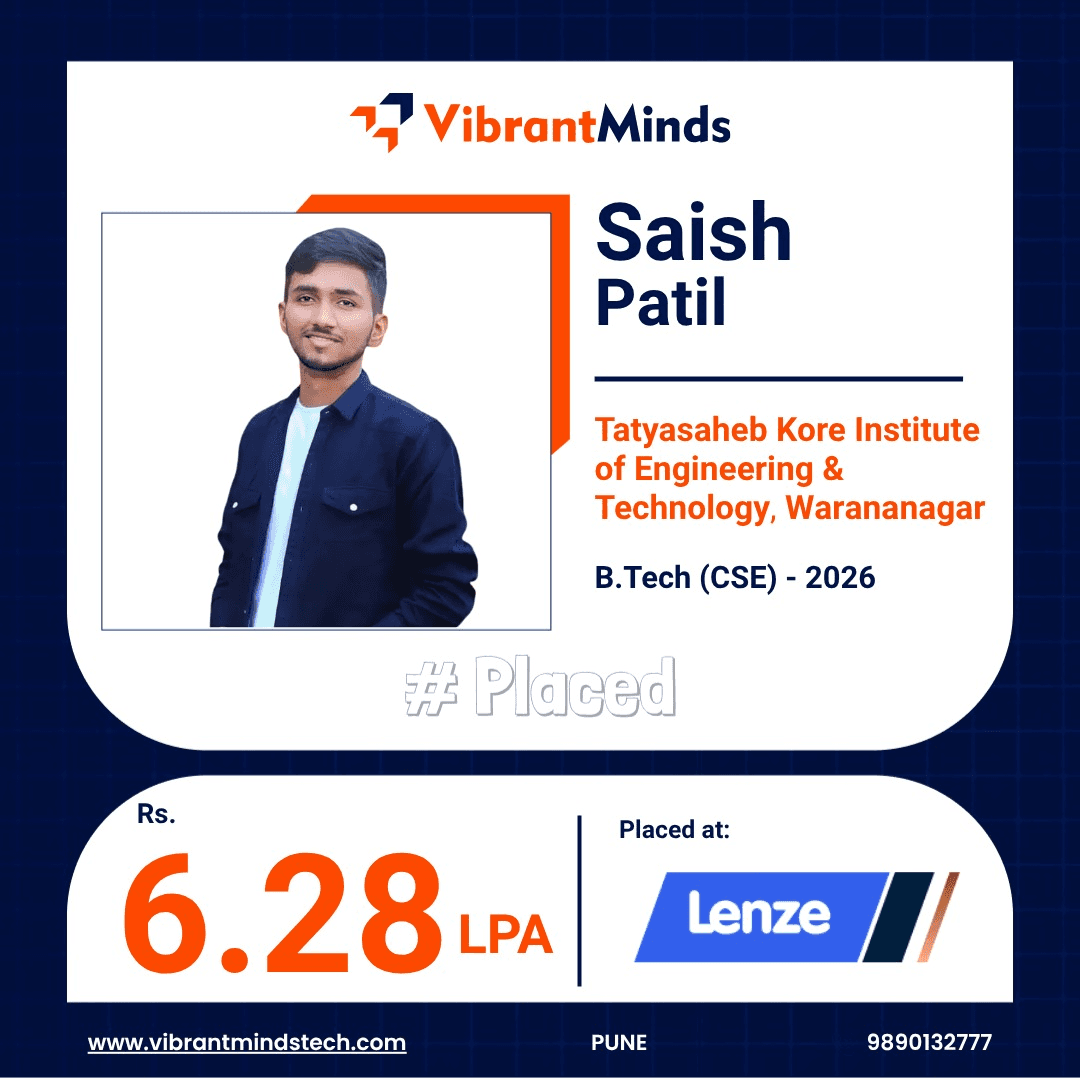
A Structured Path Into This Pipeline: VibrantMinds Technologies
Given how much of real fresher hiring runs through structured, assessment-based channels rather than open job-board applications, a placement-linked training program is one legitimate way to plug directly into that pipeline instead of navigating it alone. VibrantMinds Technologies is one such Pune-based option worth knowing about in detail — everything below is drawn from VibrantMinds' own published pages; confirm current details directly before enrolling.
• VibrantMinds Technologies Pvt. Ltd. runs a talent ecosystem connecting candidates, colleges, and hiring companies — partnering with 1900+ colleges and 600+ companies across India
• Its flagship Full Stack Java program covers Core Java, Advanced Java, frontend basics, Spring Boot, REST APIs, SQL, and dedicated interview readiness — the same skill profile that shows up repeatedly in fresher hiring assessments like TCS NQT and InfyTQ
• Training is project-based from the start — daily coding practice using real tools (Eclipse, NetBeans, Git) rather than slide-only theory sessions
• A six-stage placement pipeline runs behind its campus drives: requirement mapping, candidate sourcing, screening & assessment, drive coordination, interview support, and onboarding follow-up — mirroring, at a smaller scale, exactly the kind of structured assessment pipeline described above
• Classes run both at its Warje, Pune campus and online, so freshers outside Pune can still access the same program
For a fresher trying to build exactly the kind of demonstrable, assessment-ready skill profile this guide describes, a structured program like this compresses months of scattered self-study and unclear next steps into a defined, placement-linked path.
Detail | Information |
Flagship Program | Full Stack Java (4–6 months, batch-dependent) |
Also Offers | Software Testing, Core Java, Python & Data Science |
Format | Classroom (Warje, Pune) + Online |
Address | Viva Academy Building, Warje, Pune, Maharashtra 411052 |
Phone | +91 95035 79517 |
support@vibrantmindstech.com |
Official Website: https://vibrantminds.in/
Candidate Portal & Courses: https://candidates.vibrantminds.in/
Red Flags: "No Experience Needed" Scams to Avoid
The exact anxiety this guide addresses — "how do I get hired with zero experience" — is also what scam listings prey on. Watch for:
• Any request for payment to "process your application" or "confirm your interview" — legitimate recruiters never charge candidates
• Salary or role promises that sound disconnected from the market data above (for example, ₹8+ LPA guaranteed for a role requiring no skills at all)
• Vague company names with no verifiable website, LinkedIn presence, or physical address
• Pressure to decide or pay within hours, with no time to verify the opportunity independently
• Requests for sensitive documents (Aadhaar, bank details) before any formal offer letter has been issued
A genuine fresher opportunity — whether a direct company drive or a training-institute placement pipeline — will always be verifiable: a real company page, a real address, and people you can actually call.
Frequently Asked Questions
Q: Are there really IT jobs in 2026 that don't require any experience? Yes — large-scale fresher hiring through campus drives, national qualifier tests, and GCC entry programs is real and substantial, even though these roles are a small share of general job-board postings.
Q: Why do so many job postings say "experience required" even for junior roles? Many postings on general job boards are for lateral/experienced hiring, which dominates day-to-day listings. Fresher hiring runs through a separate, more concentrated pipeline that doesn't show up the same way in a general search.
Q: Do personal projects actually count as experience to recruiters? Yes, particularly when they're deployed and demonstrable rather than just listed — a working project with a GitHub link is treated as much stronger evidence than a claimed skill with no proof.
Q: Is a placement-linked training program worth it if I can self-study for free? It depends on your discipline and existing network. Self-study can absolutely work, but a structured program adds a defined timeline, live-project practice, and — often more importantly — direct access to a placement pipeline that's harder to build alone.
Q: How long does it realistically take to go from zero to a first offer? Based on the pattern most freshers follow, roughly 5–7 months from starting serious preparation to a placement drive is a realistic range — faster for some, slower for others, depending on starting skill level and market timing.
Bottom Line
"IT jobs for freshers without experience" isn't a myth, but it's also not as simple as applying to every posting that mentions "0 years." The real opportunity lives in a specific pipeline — campus drives, qualifier tests, GCC entry programs, and placement-linked training — that rewards demonstrable skill over a work history you can't yet have. Build real, deployed projects, target that specific pipeline rather than the general job-board firehose, and treat a structured program like VibrantMinds Technologies' Full Stack Java course as one legitimate way to compress the path — not a shortcut around doing the actual work.

