Online vs Classroom IT Training for Freshers (2026)

"Should I join an online batch or a classroom program?" is a question freshers usually answer based on convenience — whichever is cheaper, or closer, or fits their schedule. That's a reasonable starting point, but it skips the more important question: which format will you actually finish, and which one gets you interview-ready faster? This guide walks through real completion-rate data, an honest breakdown of what each format is genuinely good at, and a framework for picking the one that fits how you actually learn — not just how you'd like to imagine you learn.
Quick Verdict
For most freshers with no prior professional discipline in self-study, live classroom training produces meaningfully higher completion and placement-readiness rates than either self-paced or fully online formats — but a well-structured, live (not recorded) online cohort with a real placement team can close most of that gap. The format matters less than whether it has real accountability built in.
The Completion Rate Gap Is Real — and Larger Than Most Freshers Expect
Before comparing placement outcomes, it's worth looking at a more basic number: how many students actually finish what they start. Across published 2025–2026 EdTech benchmark studies, the gap between formats is stark:
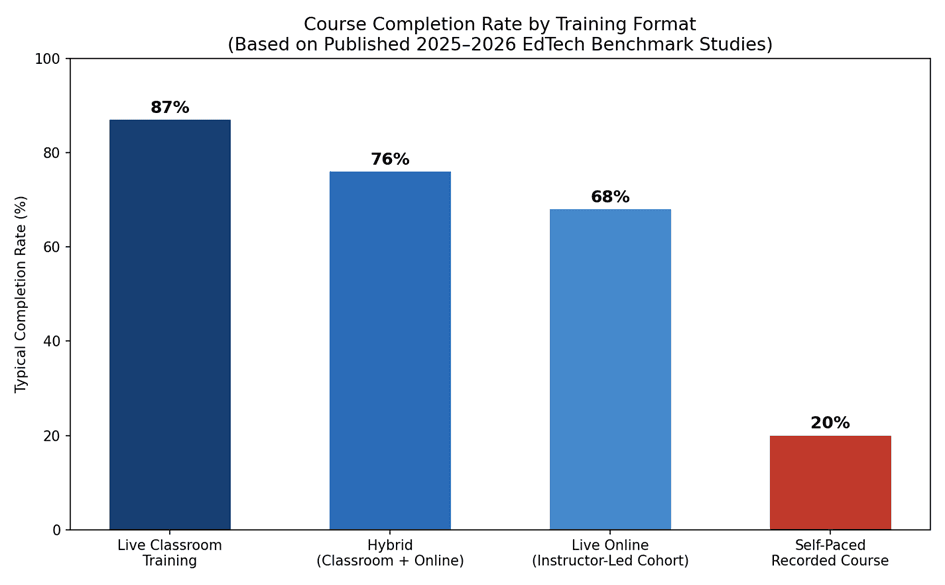
The pattern holds across nearly every study on the subject: self-paced, recorded-only courses see completion rates under 25% on large marketplaces, while live, cohort-based programs — whether online or in a classroom — routinely reach 65–90%. The single biggest driver isn't content quality. It's structure: a fixed schedule, a real instructor, and peers who notice if you disappear.
This matters enormously for placement outcomes, for an obvious reason: a course you don't finish can't get you placed, no matter how good the syllabus was.
Why Classroom Training Wins for Most Freshers
• Real-time doubt resolution — a confused student in a classroom raises a hand and gets an answer in seconds; the same confusion in a recorded course often means giving up on the topic entirely
• Peer accountability — sitting among classmates who show up daily creates a quiet social pressure to keep pace, one of the most consistently cited reasons classroom cohorts outperform self-paced formats
• Direct trainer relationships — trainers who see you struggle with a specific concept in person can adjust their teaching on the spot
• Built-in networking — classmates become part of your professional network, referring you to openings and sharing interview experiences
• External structure for people who need it — most freshers have never had to self-regulate a multi-month learning schedule without a boss or professor enforcing deadlines
When Online Training Is Genuinely the Better Choice
None of the above means online training is a lesser option in every case — it's a better fit for a specific, real set of circumstances:
• Geography — if there's no strong training institute within a reasonable commute, a good live online program beats a mediocre local classroom one, easily
• Cost sensitivity — online programs typically run somewhat cheaper, with no commute cost or time
• Proven self-discipline — freshers who've already demonstrated they can follow through on self-paced learning tend to do fine online
• Health, family, or scheduling constraints — some freshers genuinely cannot commit to a fixed daily commute
The critical distinction within "online" is between live, instructor-led cohorts and self-paced recorded courses — these are not the same thing, and treating them as interchangeable is where most freshers go wrong. A live online batch with real trainers and a fixed schedule retains most of classroom training's accountability; a stack of recorded videos does not.
Factor-by-Factor: Where Each Format Actually Wins
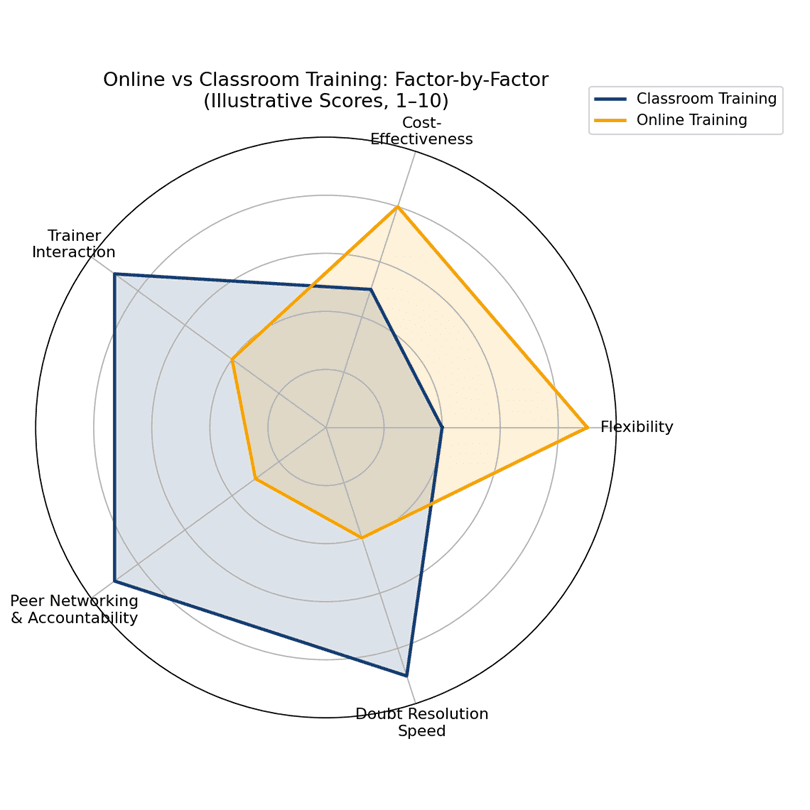
Aspect | Classroom (Offline) | Live Online |
Trainer interaction | Direct, immediate | Live, but slightly less immediate |
Peer networking | Strong — daily in-person contact | Moderate — depends on batch engagement |
Doubt resolution | Instant | Fast, if the format is genuinely live |
Flexibility | Fixed schedule, fixed location | No commute; sometimes flexible timing |
Cost | Slightly higher (facility overhead) | Typically lower |
Discipline required | Moderate — structure is external | Higher — more self-management needed |
Best fit for | Most freshers, especially first-time learners of a new stack | Disciplined self-starters, those with geographic or cost constraints |
The Hybrid Model: Increasingly, the Real Answer
The sharpest data point in the completion-rate chart above isn't at either extreme — it's the hybrid format, sitting at 76%, well above pure online and not far behind full classroom. A growing number of institutes now run both formats in parallel, or blend them: live classroom sessions for core concepts, with recorded material for revision, and online support for doubt-clearing outside class hours. This is worth actively looking for when evaluating institutes, rather than treating "online vs. classroom" as a strict either/or choice.
How VibrantMinds Technologies Handles This
VibrantMinds Technologies, a Pune-based IT training and placement company, runs its Full Stack Java program in both formats — a classroom batch at its Warje, Pune campus, and a live online batch for freshers elsewhere — rather than forcing a single delivery model on every student. Both formats cover the same syllabus (Core Java through Spring Boot, REST APIs, SQL, and interview preparation) and are backed by the same six-stage placement pipeline: requirement mapping, candidate sourcing, screening & assessment, drive coordination, interview support, and onboarding follow-up.
For a fresher weighing this exact decision, the practical takeaway is this: if you can reasonably reach the Warje campus, classroom training gives you the daily accountability and peer network the data above favors. If you can't, a genuinely live (not recorded) online batch — with the same trainers and placement pipeline behind it — is a legitimate second-best that closes most of the gap.
VibrantMinds Full Stack Java Course: https://vibrantminds.in/
VibrantMinds Candidate Portal: https://candidates.vibrantminds.in/
A Quick Decision Framework
• Choose classroom if: you're new to structured self-study, you can commute reasonably, and you value direct trainer access and peer networking
• Choose live online if: geography or cost rules out classroom access, and you have a track record of finishing what you start without external enforcement
• Avoid self-paced recorded-only courses as your primary path if placement is your actual goal — the completion-rate data above makes a strong case that this format alone rarely gets freshers job-ready on schedule
• Whichever you choose, verify it's genuinely live — ask directly whether sessions are live with real-time interaction, or pre-recorded content repackaged as an "online batch"
Frequently Asked Questions
Q: Is online training ever actually better than classroom for freshers? Yes, specifically when it's genuinely live and instructor-led, and when geography, cost, or scheduling make classroom access impractical. It's the self-paced, recorded-only format that shows consistently weaker outcomes — not "online" as a category.
Q: Do recruiters care whether I trained online or in a classroom? Almost never directly — recruiters evaluate skills and interview performance, not training format. The format matters because of how it affects whether you actually built those skills in the first place.
Q: What's the biggest mistake freshers make when choosing between formats? Underestimating how much self-discipline a fully self-paced format demands. Most freshers have never managed a multi-month learning schedule without external structure, and significantly overestimate their own follow-through.
Q: Can I switch formats partway through if one isn't working? Many institutes that offer both formats allow this, though policies vary — it's worth asking directly before enrolling if you're genuinely unsure which format fits you.
Bottom Line
The format debate matters less than most freshers assume — what actually predicts placement outcomes is whether the program has real structure, real accountability, and a real placement pipeline behind it, regardless of delivery mode. If you're choosing between a live classroom seat and a live online batch from the same institute with the same trainers, pick based on your own logistics and self-discipline, not brand perception. If you're choosing between any live program and a self-paced recorded course, the completion-rate data above makes the case clearly: live beats recorded, almost every time.
Data on completion rates and outcomes is drawn from published 2025–2026 EdTech benchmark studies; individual institute results vary. Verify specific claims directly with any institute before enrolling.

