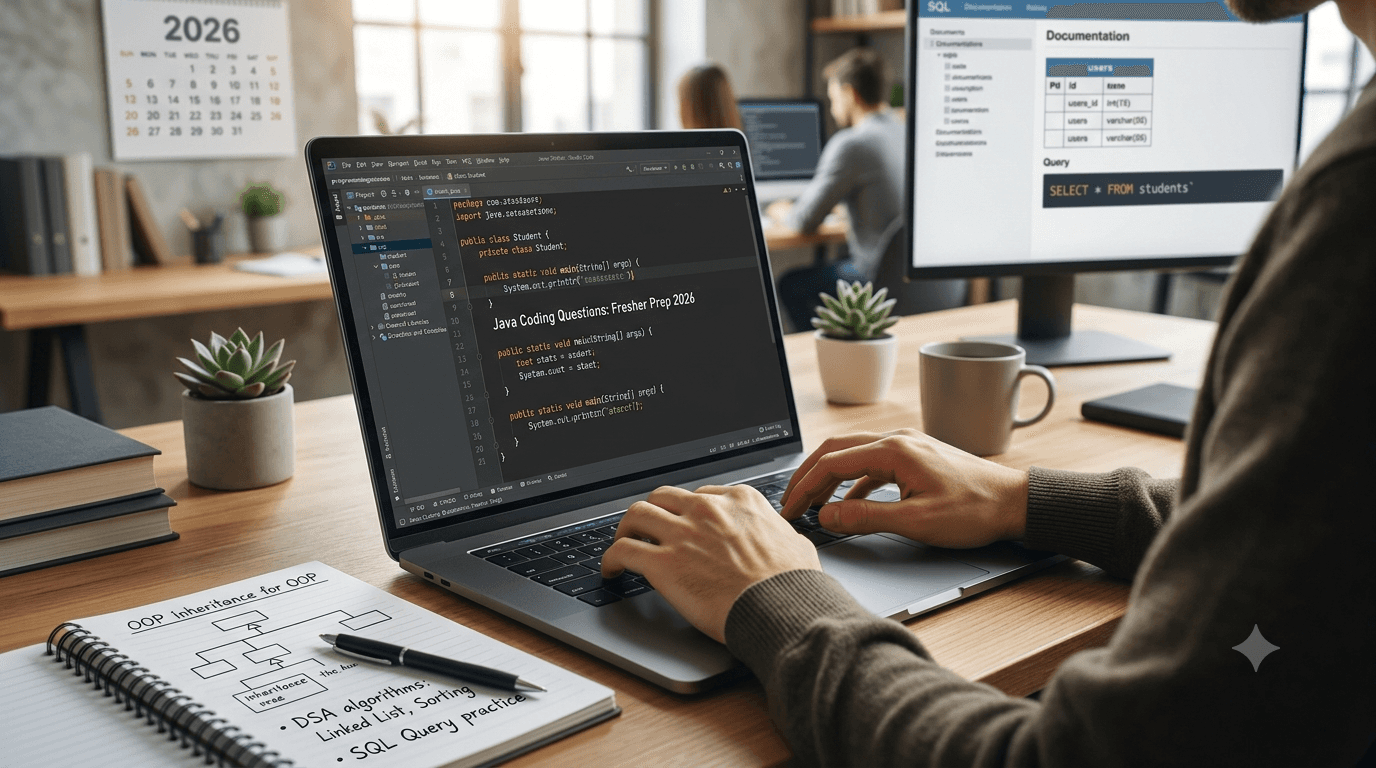
Top Skills Freshers Need to Get a Software Job in 2026

Getting a software job as a fresher is no longer only about having a degree or completing a few online courses. In 2026, employers are increasingly looking for candidates who can demonstrate practical skills, solve problems, work with modern technologies, and adapt to changing tools.
Recent hiring reports point toward a stronger skills-first approach, with practical ability, digital readiness, AI and data skills, and proof of work becoming increasingly important in fresher hiring.
This creates an important question for students and recent graduates:
What skills should a fresher actually learn to get a software job in 2026?
The answer is not to learn every programming language or every new technology.
Instead, freshers should build a strong technical foundation, develop practical experience, understand how modern software teams work, and improve the professional skills required to perform well during interviews and on the job.
Quick Summary: Skills Freshers Should Prioritize
Skill | Importance for Freshers |
|---|---|
Programming | Essential |
Data Structures & Algorithms | High |
SQL & Databases | Essential for many software roles |
Git & GitHub | Important |
Software Development | Essential |
Practical Projects | Very Important |
AI Literacy | Increasingly Important |
Cloud Fundamentals | Valuable |
Problem Solving | Essential |
Communication | Essential |
Adaptability | Important |
Interview Preparation | Essential |
The important point is that freshers do not need to master everything simultaneously.
A focused combination of skills is generally more valuable than having dozens of technologies listed on a resume without practical knowledge.
1. Programming Skills
Programming is the foundation of most software development careers.
Freshers should become genuinely comfortable with at least one primary programming language instead of learning five languages superficially.
Popular choices include:
Java
Python
JavaScript
C#
C++
For students targeting enterprise software development, Java remains a strong option because it can be used across backend development, web applications, APIs, and full-stack development.
The important part is not simply knowing syntax.
You should understand:
Variables and data types
Conditional statements
Loops
Functions and methods
Object-Oriented Programming
Collections
Exception handling
File handling
Debugging
Basic problem solving
What Recruiters Want to See
Instead of saying:
"I know Java."
A stronger candidate can demonstrate:
"I can use Java to build a small application, work with a database, create APIs, debug problems, and explain my code."
That difference represents the move from course completion to job readiness.
2. Data Structures and Algorithms
Data Structures and Algorithms, commonly called DSA, are important for technical interviews.
Freshers may encounter coding assessments involving:
Arrays
Strings
Linked lists
Stacks
Queues
Hashing
Trees
Searching
Sorting
Recursion
Basic algorithms
Time and space complexity
You do not need to solve extremely difficult problems from day one.
Start with basic problems and gradually increase the difficulty.
A Simple DSA Learning Path
The objective is not memorizing solutions.
It is learning how to think through a problem logically.
3. SQL and Database Skills
SQL is one of the most practical skills for software development roles.
Even if you want to become a frontend or full-stack developer, understanding how applications store and retrieve information is valuable.
Freshers should understand:
SELECT statements
WHERE conditions
ORDER BY
GROUP BY
Aggregate functions
Joins
Subqueries
Primary keys
Foreign keys
Constraints
Normalization
CRUD operations
Database relationships
Basic database design
For Java developers, SQL becomes especially useful when working with technologies such as JDBC, Hibernate, and Spring Boot.
A fresher who can explain how a frontend request reaches a backend service and eventually retrieves data from a database demonstrates a much stronger understanding of application development.
4. Software Development Skills
Knowing programming syntax is only one part of becoming a software developer.
Freshers should understand how software is actually developed.
Important areas include:
Requirements understanding
Application design
Backend development
Frontend development
API development
Database integration
Testing
Debugging
Version control
Deployment basics
For example, a Java Full Stack learner could follow a development path such as:
Java → SQL → Spring Boot → REST APIs → HTML/CSS/JavaScript → React → Git → Project Development
This creates a connected learning path rather than a collection of unrelated technologies.
5. Git and GitHub
A fresher's learning does not end after writing code on a personal laptop.
Learning Git and GitHub helps students understand version control and how development work can be managed collaboratively.
Freshers should know how to:
Create a Git repository
Commit changes
Create branches
Merge changes
Push and pull code
Resolve basic conflicts
Maintain a useful GitHub profile
More importantly, GitHub can become a place where candidates show evidence of their skills.
A well-organized project repository can demonstrate:
Code quality
Project structure
Consistency
Documentation
Problem-solving ability
Practical development experience
6. Practical Project Experience
One of the biggest differences between a course-completing student and a job-ready fresher is practical experience.
Instead of building only tutorial projects, create applications that solve realistic problems.
Examples include:
Job portals
E-commerce applications
Employee management systems
Banking applications
Learning management systems
Inventory management systems
Expense trackers
Appointment booking applications
A good project should demonstrate multiple skills.
For example:
When you build a project this way, you gain something more valuable than another certificate: proof that you can apply what you have learned.
7. AI Literacy
AI is one of the biggest changes affecting software careers in 2026.
However, AI literacy does not mean every fresher needs to become a machine-learning engineer.
For most software aspirants, it means understanding how to use AI tools responsibly and productively while still knowing how to verify the output.
Freshers should learn:
Basic Generative AI concepts
Prompt writing
AI-assisted coding
Code explanation
Debugging with AI assistance
AI limitations
Output verification
Responsible AI usage
Basic understanding of APIs and AI-powered applications
Current research and hiring commentary increasingly point toward AI skills becoming a useful hiring signal, while software professionals still need strong core engineering knowledge.
The important rule is:
Use AI to improve your development process, not to replace your understanding of programming.
If an AI tool generates code, you should be able to explain what the code does, identify potential problems, and modify it when requirements change.
8. Problem-Solving and Logical Thinking
Technical skills become much more valuable when you can use them to solve unfamiliar problems.
Interviewers may give you a problem you've never seen before.
They want to understand how you approach it.
Develop your ability to:
Understand the problem.
Break it into smaller parts.
Identify possible solutions.
Compare approaches.
Write the solution.
Test edge cases.
Improve the solution.
This is why coding practice and DSA should not be treated only as interview preparation.
They help develop the thinking process required for software development.
What Freshers Should Remember
You do not need to learn 20 technologies before applying for your first job.
A better strategy is:
The goal is to become demonstrably capable, not simply to make your resume longer.
9. Cloud Computing Fundamentals
Cloud computing has become an important part of modern software development. Freshers do not necessarily need to become cloud experts before applying for their first software job, but understanding the basics can make their technical profile stronger.
Start with fundamental concepts such as:
What cloud computing means
Servers and virtual machines
Storage
Databases
APIs
Deployment
Containers
Basic cloud security
Scalability
Monitoring
You can then explore platforms such as AWS, Microsoft Azure, or Google Cloud.
For a fresher, the goal is not to collect multiple cloud certifications. It is better to understand how a simple application can be hosted, connected to a database, and accessed through the internet.
10. Communication Skills
Technical knowledge may help you reach an interview, but communication can influence how effectively you explain your knowledge.
Software developers regularly communicate with:
Team members
Senior developers
Project managers
QA engineers
Clients
HR teams
Freshers should practice explaining technical concepts in simple language.
For example, if an interviewer asks:
"Explain your project."
Do not simply list technologies.
Instead, explain:
What problem the project solves
What your role was
Which technologies you used
How the application works
What challenges you faced
How you solved those challenges
What you learned
Good communication is not about using complicated English. It is about expressing your ideas clearly and confidently.
11. Teamwork and Collaboration
Software development is rarely an individual activity.
Even entry-level developers may work with developers, testers, designers, business teams, and project managers.
Freshers should understand basic collaboration practices such as:
Sharing code using Git
Working with branches
Reviewing code
Discussing requirements
Reporting issues
Giving and receiving feedback
Participating in team discussions
Projects completed with a small team can also help demonstrate collaboration skills during interviews.
The World Economic Forum's Future of Jobs research identifies collaboration and other human skills alongside technology skills as important in a changing labour market.
12. Adaptability and Continuous Learning
Technology changes quickly.
A programming language or framework you learn today may receive major updates tomorrow. New development tools, AI assistants, frameworks, and platforms can also change how software is built.
Therefore, one of the most valuable skills for a fresher is the ability to learn continuously.
Develop habits such as:
Reading official documentation
Building small experiments
Following technology updates
Learning from errors
Asking useful questions
Practicing consistently
Exploring unfamiliar tools
The World Economic Forum expects a significant share of workers' core skills to change by 2030, reinforcing the importance of reskilling and adaptability.
13. Testing and Debugging Skills
A fresher who can only write code but cannot identify why the code fails may struggle in real development environments.
Learn the basics of:
Debugging
Unit testing
Integration testing
Error handling
Logging
Test cases
API testing
Browser developer tools
For example, when an API does not return the expected response, you should be able to investigate whether the problem is related to:
Frontend → API → Backend → Database
This type of systematic troubleshooting is valuable in software development.
14. Basic Cybersecurity Awareness
You do not need to become a cybersecurity specialist to understand basic security principles.
However, developers should know why applications need protection.
Learn concepts such as:
Authentication
Authorization
Password security
Input validation
Secure API usage
SQL injection
Cross-site scripting
HTTPS
Sensitive data protection
Understanding these concepts can help you write safer applications and answer basic security questions during interviews.
15. Resume and Portfolio Skills
Having skills is important, but recruiters also need a way to evaluate them.
Your resume should clearly communicate:
Technical skills
Projects
Internships
Education
Certifications
Achievements
Relevant experience
Avoid filling your resume with every technology you have ever watched a tutorial about.
Instead, focus on skills you can actually demonstrate.
Weak Resume Skill Section
Java, Python, C++, JavaScript, React, Angular, Node.js, AWS, Docker, Kubernetes, AI, ML, Blockchain, etc.
If you cannot confidently answer questions about these technologies, the long list may work against you.
Stronger Approach
Java: OOP, Collections, Exception Handling, JDBC
Backend: Spring Boot, REST APIs
Database: SQL, MySQL
Frontend: HTML, CSS, JavaScript, React
Tools: Git, GitHub, Maven
Projects: Job Portal, Employee Management System
The second approach gives recruiters a clearer picture of your actual capabilities.
16. Interview Preparation
Even technically strong candidates can struggle if they have never practiced interviews.
Freshers should prepare for several stages.
Technical Round
Prepare:
Programming fundamentals
OOP
DSA
SQL
DBMS
Projects
Frameworks
APIs
Debugging
Coding Assessment
Practice:
Arrays
Strings
Basic algorithms
Logical problems
SQL queries
Time-bound coding
HR Round
Prepare for questions such as:
Tell me about yourself.
Why should we hire you?
Why did you choose software development?
Explain your project.
What are your strengths?
What are you currently learning?
Where do you see yourself in the next few years?
The objective is not to memorize answers.
Prepare your experiences and learn how to communicate them naturally.
The Ideal Fresher Skill Stack in 2026
You don't need every technology available in the market.
A focused skill stack is usually more practical.
Skill Area | Beginner Priority | Example Technologies |
|---|---|---|
Programming | Essential | Java / Python / JavaScript |
DSA | High | Arrays, Strings, Trees, Sorting |
Database | Essential | SQL, MySQL |
Backend | High | Spring Boot / Node.js / Django |
Frontend | High | HTML, CSS, JavaScript, React |
Version Control | High | Git, GitHub |
APIs | High | REST APIs |
Cloud | Medium | AWS / Azure / Google Cloud |
AI Literacy | Increasingly Important | Generative AI, AI-assisted development |
Testing | Medium | Unit Testing, API Testing |
Security | Medium | Authentication, Secure APIs |
Communication | Essential | Technical + professional communication |
Projects | Essential | Realistic applications |
Interview Skills | Essential | Coding + technical + HR |
Which Skills Should You Learn First?
One of the biggest mistakes freshers make is trying to learn everything at once.
Instead, follow a structured sequence.
Fresher Skill Roadmap for 2026
Java Full Stack Example for Freshers
If your goal is to become a Java Full Stack Developer, your learning path could look like this:
Core Java → Advanced Java → SQL → JDBC → Hibernate → Spring → Spring Boot → REST APIs → HTML → CSS → JavaScript → React → Git/GitHub → Projects → DSA → Interview Preparation
This approach allows you to build both backend and frontend development capabilities while developing the practical skills needed to create complete applications.
How to Become Job-Ready Instead of Just Course-Ready
Completing a course does not automatically make someone job-ready.
A better test is to ask yourself:
Can I build something?
If yes, you are developing practical ability.
Can I explain my code?
If yes, you understand what you built.
Can I debug an error?
If yes, you are developing real development skills.
Can I solve an unfamiliar coding problem?
If yes, your problem-solving ability is improving.
Can I explain my project to an interviewer?
If yes, you are becoming interview-ready.
This is why skills + projects + communication + interview preparation should be developed together.
Common Mistakes Freshers Should Avoid
Mistake 1: Learning Too Many Technologies
Do not spend two weeks on Java, then switch to Python, then React, then AI, then cloud without mastering a core skill.
Better approach: Choose one career path and build depth first.
Mistake 2: Collecting Certificates Without Projects
Certificates can demonstrate learning activity, but projects provide evidence of practical application.
Better approach: For every major technology you learn, try building something with it.
Mistake 3: Ignoring DSA
Some freshers focus entirely on frameworks and ignore coding fundamentals.
Better approach: Practice DSA consistently alongside development.
Mistake 4: Ignoring Communication
A candidate may know the answer but struggle to explain it.
Better approach: Practice explaining your projects and technical concepts aloud.
Mistake 5: Using AI Without Understanding the Code
AI tools can accelerate development, but blindly copying generated code can create problems during interviews and real projects.
Better approach: Use AI as a learning and development assistant, then verify and understand the output.
Research published in 2026 also suggests that AI-related skills can act as a positive hiring signal, including in software-engineering hiring experiments.
What Should a Fresher Focus on in the Next 6 Months?
Month | Main Focus |
|---|---|
Month 1 | Programming fundamentals |
Month 2 | Advanced programming + SQL |
Month 3 | DSA + backend development |
Month 4 | Frontend + APIs + Git |
Month 5 | Practical projects + AI/cloud basics |
Month 6 | Resume + coding tests + mock interviews + job applications |
The exact timeline can vary depending on your starting level and the role you are targeting.
How VibrantMinds Technologies Can Support Fresher Skill Development
For students who prefer structured learning, VibrantMinds Technologies Pvt. Ltd. can be considered as one option for developing software-development and career-preparation skills.
Its learning approach can combine areas such as:
Java Full Stack development
Core and Advanced Java
SQL
Spring and Spring Boot
Hibernate
REST APIs
HTML, CSS and JavaScript
Practical projects
Aptitude preparation
Communication development
Resume guidance
Mock interviews
Career mentoring
Placement assistance
The most important thing for students is to use training as a foundation and continue practicing independently. The objective should be to leave the course with skills and demonstrable project experience, not simply a certificate.
Fresher Job-Readiness Checklist
Before applying for software jobs, ask yourself:
Can I confidently code in one programming language?
Do I understand OOP?
Can I write SQL queries?
Have I practiced DSA?
Can I build a basic application?
Can I create or consume REST APIs?
Do I understand Git and GitHub?
Do I have 2–3 meaningful projects?
Can I explain every project on my resume?
Do I understand basic AI tools and their limitations?
Can I communicate my ideas clearly?
Have I practiced technical interviews?
Have I prepared for HR interviews?
Is my resume focused on relevant skills?
If you can check most of these boxes, you are moving much closer to being job-ready.
Frequently Asked Questions
1. What are the most important skills freshers need for software jobs in 2026?
The most important skills include programming, DSA, SQL, software development, practical projects, Git, AI literacy, problem-solving, communication, adaptability, and interview preparation.
2. Which programming language should a fresher learn first?
There is no single correct choice for everyone. Java, Python, JavaScript, C#, and C++ can all be useful depending on the career path. Choose one language and develop strong fundamentals before adding more.
3. Is AI a necessary skill for freshers in 2026?
AI literacy is increasingly valuable, but freshers should not ignore core programming and software-engineering fundamentals. Understanding how to use AI tools effectively and verify their output is more useful than simply listing AI on a resume.
4. Is DSA necessary for software jobs?
DSA is particularly important for coding assessments and technical interviews. The depth required varies by company and role, but basic problem-solving and data-structure knowledge are valuable.
5. Are projects important for freshers?
Yes. Projects give candidates an opportunity to demonstrate practical skills and explain how they applied technologies to solve problems.
6. Should freshers learn cloud computing?
Learning basic cloud concepts is useful, especially for software-development and DevOps-related roles. Beginners can start with fundamentals before pursuing advanced certifications.
7. How many projects should a fresher have?
There is no fixed number. Two or three well-built, explainable projects are generally more useful than many unfinished tutorial projects.
8. Can communication skills affect a fresher's job search?
Yes. Developers need to communicate requirements, explain technical decisions, collaborate with teams, and participate in interviews.
9. Should freshers learn multiple programming languages?
Not initially. It is generally better to become proficient in one primary language and then add another when your career path requires it.
10. How can I prove my technical skills to recruiters?
Use practical projects, GitHub repositories, internships, coding profiles, portfolios, and clear project descriptions on your resume.
11. How long does it take to become job-ready?
It depends on your starting point, available study time, career path, and consistency. A structured learning plan combined with regular practice and projects is more important than a fixed number of months.
12. What is more important: certificates or skills?
For software-development roles, demonstrable skills and practical experience are critical. Certifications can supplement your profile, but they should not replace coding practice and projects.